What 3D rendering actually costs.
A studio interior render costs US$249 to $1,500 an image and takes days. Licensing a renderer starts at US$96.90 a month, before anyone models anything. Rendering from a floor plan costs 70 credits, which is Rs 23.33, and takes minutes. Rendering is bought those three ways, and the gap between the prices is really a gap between three different deliverables.
Updated · RoomGen Studio
How much does 3D rendering cost
For a single interior image, US$249 to $1,500 covers the published outsourced market: Render3DQuick starts interiors at $249 each, and RealSpace3D quotes $600 to $1,500 for a residential interior. Priced as a whole job rather than per image, Cad Crowd puts a residential interior at $300 to $750. Freelancers working by the hour charge $50 to $150. Rendering from a floor plan is priced in credits instead and lands at 70 credits, or Rs 23.33, per standard image.
Those numbers are not competing quotes for the same job. They are three different purchases, and the table below is the honest version of the comparison.
| Route | Price per image | Turnaround | Best for |
|---|---|---|---|
| Outsource to a studio | US$249 to $1,500 | Several days | Final images once the scheme is signed off |
| License software, render in-house | US$96.90 per month for one seat, plus the modeling hours | Hours, once the model stands | Practices already modeling for construction |
| Render from the floor plan | 70 credits, Rs 23.33, under 30 cents on a $19 plan | Minutes | Concept stage, options, live client meetings |
Three renders of one living room make the spread concrete. Outsourced, three images at the published per-image rates come to $747 to $4,500 before any multi-view discount, and most of a week. In-house, it is one license month plus the modeling day, cheap if the model already exists and expensive if it has to be built. From the plan, it is 210 credits, or Rs 70, and minutes.
Outsourcing to a studio: $249 to $1,500 per interior image
You send a plan, references and a brief; a studio returns a finished photoreal image. The two published rate cards bracket the range: $249 each at the entry end, and $600 to $1,500 for a residential interior at the considered end. Independent artists span wider in both directions.
The price buys craft, and it buys a schedule. Revision rounds are capped at one or two on Render3DQuick’s terms and two or threeon RealSpace3D’s, and a change requested past the cap arrives with a fee. That suits a signed-off scheme heading for a brochure. It suits an early concept conversation poorly, because the concept conversation is the one that changes most.
Rendering in-house: software, hardware and the hours nobody prices
The traditional stack is a modeling application, a renderer on top, and hardware capable of driving it. Taking one widely used real-time renderer as the marker, Enscape publishes US$96.90 per month for a single Solo seat billed month to month, or $574.80 for a year paid up front. That is one layer. The modeling license underneath it, the asset libraries and the workstation are separate.
The real cost here is rarely the license. It is the person operating it. Modeling a room to a renderable standard takes months to learn and hours to apply, and those hours land before the first presentable image exists. For a practice already producing construction detail the model is being built anyway, so the render is close to free. For a practice that stops at scheme design, the model is pure overhead.
Rendering from a floor plan: cost per image and what it skips
The newer option removes the modeling step. The floor plan already carries the walls, the openings and the dimensions, which is most of what a picture needs, so the rooms get furnished at true scale and rendered directly.
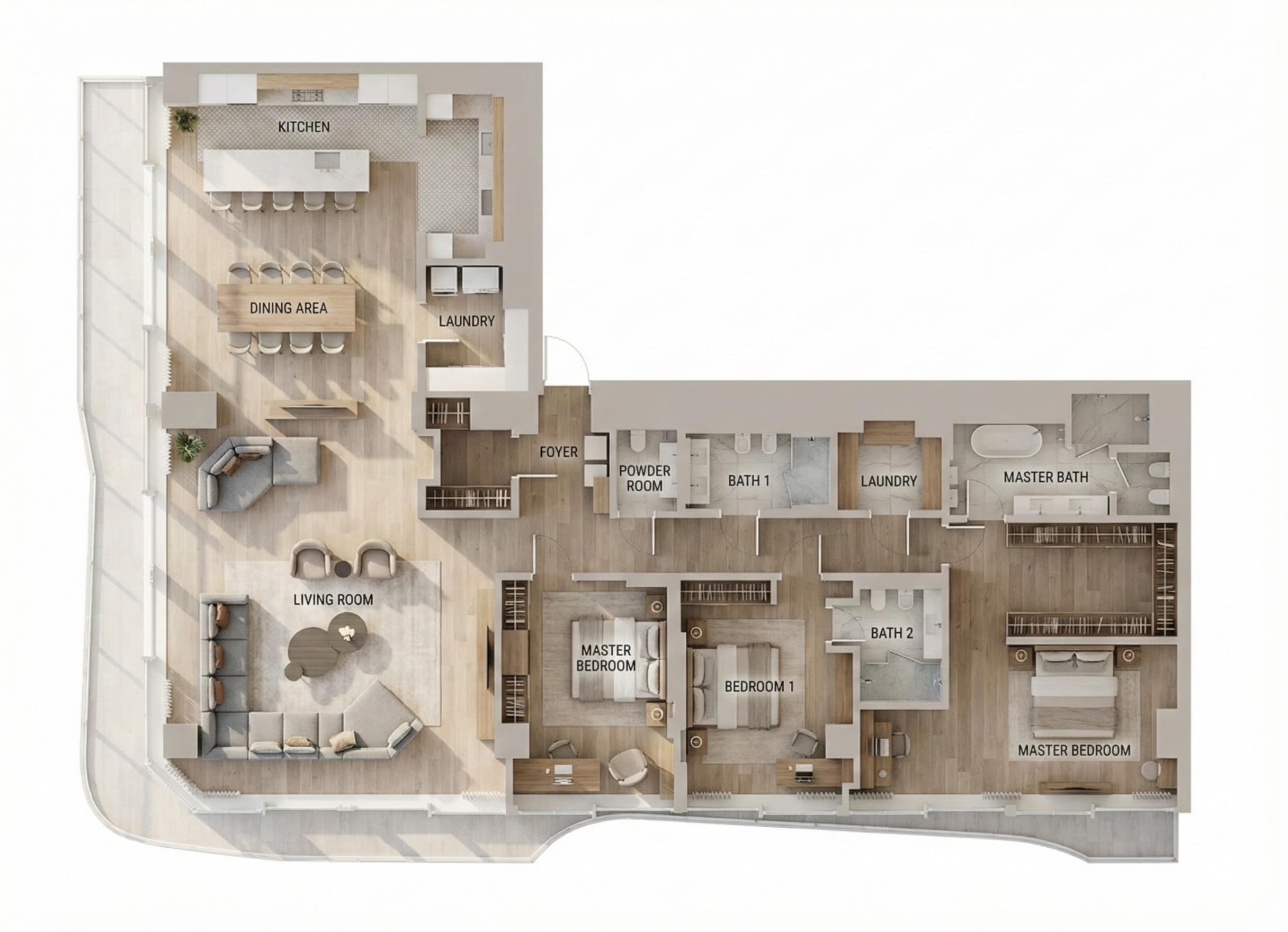
Pricing here works in credits against a monthly allowance, so the table gives the rupee figure too. The rate is fixed and public: 3 credits is Rs 1, so you can check every row by dividing the credit figure by three. The last column is different arithmetic: it is the $19 Studio plan, which grants 4,500 credits a month, spread across the images those credits buy. That is plan amortisation, not a currency conversion, and there is deliberately no dollar price on the credits themselves.
| Output | Credits | Rupees | Images per month on a $19 plan | Cost per image, amortised |
|---|---|---|---|---|
| Concept | About 21, at most 52 | About Rs 7.00, at most Rs 17.33 | 214 | About 9 cents |
| Preview | 50 | Rs 16.67 | 90 | About 21 cents |
| Standard render | 70 | Rs 23.33 | 63 | Under 31 cents |
| Hero | 150 | Rs 50.00 | 29 | About 66 cents |
The tool screen quotes the tier before you spend anything, and it opens on Preview at 50 credits. Standard at 70 is the tier this guide compares against, because it is the one that stands up as a client-facing image. New accounts open with 100 free credits, which covers two renders with the styling tools before any payment details. Floor-plan renders like the ones priced here need a paid plan.
The mechanics are covered in floor plan to 3D render, and the honest limits of the approach in design software that skips SketchUp.
3D rendering prices by type: interior, exterior, floor plan, animation
An interior is among the cheapest things a studio renders. If your project needs the exterior, an aerial view or a walkthrough, the price moves by multiples rather than percentages. Two studios publish full rate cards, and putting them side by side shows both the level and the spread.
| Render type | Render3DQuick, from | RealSpace3D, range | Turnaround |
|---|---|---|---|
| 3D interior | $249 each | $600 to $1,500 | 3 to 6 days |
| 3D exterior | $499 each | $800 to $2,500 | 3 to 8 days |
| 3D floor plan | $299 per floor | $300 to $800 | 3 to 6 days |
| Aerial | $799 each | $1,000 to $3,000 | 5 to 10 days |
| Animation | $2,500 per minute | $4,000 to $12,000 per finished minute | 1 to 4 weeks |
| Product | Not listed | $250 to $900 | 2 to 4 days |
Each turnaround row is the wider of the two quoted windows. Render3DQuick summarises its own card as $249 to $2,500 per image; RealSpace3D describes a bottom tier at $99 to $200 it advises caution about, a basic presentation band of $300 to $400, a mid-level band of $400 to $3,000 and a high end of $3,000 to $14,000 and up. A designer pricing one living room is shopping in the lower bands, which is why the $249 starting price and the $300 to $750 job figure sit so close together.
Per image, per hour or per project: how rendering is quoted
Three units are in circulation and they are not interchangeable, so ask a supplier which one they are quoting. Per image is the common unit and the one the tables above use. It also hides scope: one image can absorb a day of modeling and still be billed as a single line. Per hour is how freelancers usually work, at $50 to $150 an houron Render3DQuick’s figures, which is honest about time but leaves you carrying the risk on how long the job takes. Per project is a bundle, quoted at $300 to $1,000 and up for freelance work on the same source, and it is where volume discounts live: RealSpace3D publishes 15 to 30 percent off for four or more views ordered together. If you need a set, ask for the set price rather than multiplying the single-image rate.
What makes one render cost more than another
Room complexity and fidelity move the base price, but the line items that actually surprise people sit after the quote. RealSpace3D publishes both: extra revision rounds beyond the included ones run $100 to $400 each, and rush work carries a 25 to 50 percent premium. Between them, a change of mind and a compressed deadline can add more to an invoice than the choice of studio did.
Render3DQuick names the same problem from the other end, arguing that what inflates a rendering bill is an ambiguous brief rather than a complicated room. Both point at splitting your renders by purpose. The images that exist to settle a direction get revised repeatedly, and revision is the expensive part of the outsourced route and the cheap part of every other one.
The comparison is honest only where the three produce interchangeable output. For a scheme presentation they broadly do. For a magazine hero image the studio render remains a different class of product, and for construction visuals tied to a live model the in-house stack is the only one that qualifies.
Turnaround time, which is often the real constraint
Budget gets the attention while schedule does the damage. An outsourced render arrives in days, an in-house render in hours once the model stands, and a plan-driven render in minutes. When a client asks to see the sofa in another fabric mid-meeting, only one of the three answers while the meeting is still happening.
The published windows back this up. Render3DQuick quotes 3 to 4 days for an interior and 1 to 2 weeks for an animation; RealSpace3D quotes 3 to 6 days for a residential interior and 2 to 4 weeks for architectural animation. Rush fees exist precisely because those windows are real.
How to price renders into your design fee
- Separate billable deliverables from the internal images that win the work. The second kind should be cheap enough to be disposable.
- Quote visualisation as a line item with a stated number of images and revision rounds. Ambiguity here is where render budgets overrun.
- Price the concept stage on speed. Three directions in a day wins projects; one perfect image in a week loses them.
- Reserve the expensive route for the final image, once the client has committed and the picture becomes marketing.
- Charge for revisions beyond the stated rounds, whichever route made the image. Absorbing them on cheap renders spreads the habit to dear ones.

Scandi
Mid-century

Industrial
Two neighbouring costs have their own pages rather than a paragraph here. Staging an empty property to sell it is a different job with a different rate card, priced in virtual staging cost, and whether it returns the money is argued out in is virtual staging worth it. This page stays with design renders billed into a design fee.
How these figures were checked
The vendor figures were read on 8 September 2026from three named sources. Render3DQuick’s How much does 3D rendering cost(last updated 30 March 2026, Alex Smith) gives the from-prices, the freelance hourly and per-project bands and the $249 to $2,500 summary. RealSpace3D’s 3D rendering pricing guide(last updated April 2026) gives the ranges, the quality tiers, the revision and rush fees and the volume discount. Cad Crowd gives the $300 to $750 per-project figure. Enscape prices came from the vendor’s own store in August 2026, with the $574.80 annual total re-checked today.
One caution when you check software prices. Pricing toggles default to annual billing, so a headline monthly figure is often the yearly total divided by twelve. Enscape is exactly this case: the store shows $47.90 a month on the annual toggle, which is $574.80 over twelve rather than a month-to-month price.
The credit and rupee figures are ours and come from the billing code rather than a marketing page: 3 credits is Rs 1, the four render tiers cost 21, 50, 70 and 150 credits, and the Studio plan is $19 a month for 4,500 credits. The cents column is that plan divided across the images it buys. We publish no dollar price per credit, because converting one would mean asserting an exchange rate we have no business asserting.
Common questions
How much does a 3D interior rendering cost?
Between US$249 and $1,500 per image from a studio. Render3DQuick starts interiors at $249, and RealSpace3D quotes $600 to $1,500 for a residential interior. Cad Crowd puts a whole residential job at $300 to $750. Rendering from a floor plan instead costs 70 credits, which is Rs 23.33, or under 30 cents of a $19 plan granting 4,500 credits.
How long does a 3D render take?
Days for outsourced work, hours in-house, minutes from a floor plan. Render3DQuick quotes 3 to 4 days for interiors and 5 to 6 for aerials; RealSpace3D quotes 3 to 6 days for residential interiors and 2 to 4 weeks for animation. Schedule usually does more damage to a project than budget does.
Is rendering from a floor plan cheaper than hiring a 3D artist?
Per image, by a wide margin: 70 credits, or Rs 23.33, against a studio floor of US$249 and a residential interior range of $600 to $1,500. The comparison holds where the two produce interchangeable output, which covers scheme presentation. A hero image for a magazine spread is still a different class of product, and construction visuals tied to a live model stay in-house.
How should I price renders into my design fee?
Quote visualisation as a line item with a stated number of images and revision rounds, then charge for revisions beyond them. RealSpace3D bills extra rounds at $100 to $400 each and rush work at a 25 to 50 percent premium, which is the shape worth copying. Reserve the expensive route for the final image.
Do I need a powerful computer to render interiors?
Only for the in-house route, which needs a modeling license, a renderer on top and hardware to drive it, all priced separately. Enscape publishes US$96.90 a month for a single Solo seat. Rendering from the plan moves the work onto a server, so the spend is credits and your machine stays whatever you already own.
Try it on your own plan
Upload a floor plan or a room photo and see the first renders in about thirty seconds.
100 free credits · no credit card required
Get the next guide when it lands
We publish these as we work through what people actually ask about pricing, staging and turnaround. Leave an address to hear when a new one goes up.
Solo usamos tu dirección para escribirte sobre RoomGen. Política de privacidad · Términos